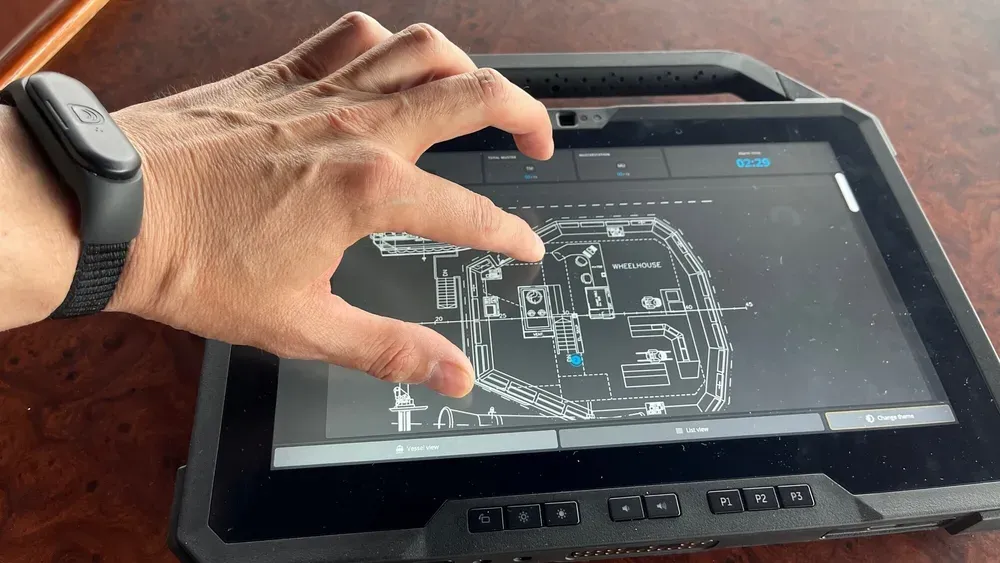
Dimeq has developed a security system for ships. It consists of nodes for communication, software on a PC and electronic wristbands.
A wristband gives the captain digital control over crew and passengers
A wristband and a network on board the ship can ensure that the captain has control over passengers and crew. A fishing vessel and a seismic company are pilot customers.
Every year several thousand fishermen die worldwide, 30-40 people fall overboard from cruise ships, and ships start burning so people have to be counted and evacuated. The big problem is knowing what is happening, where people are, who has been evacuated and possibly who is missing. Engineer Ronny Bakke and his father Audun Viktor Bakke began to discuss and seek a solution to this in 2017.
Security is too poor. There was no good system on the market that could tell where people on board were. We had to find out ourselves
says Ronny Bakke to TU.
The solution
Engineer Ronny Bakke and his father - with 40 years’ experience as a captain - put their heads in the water. They did not spend more than a year looking for a technical solution and got hold of a person with extensive knowledge of wireless communication. From demo version to a more functional version took a little more time. After five years of work, they see that the invention is starting to take off. The solution Bakke came up with consists of an electronic bracelet with an accelerometer, barometer and several transmitters and a network with several nodes that are mounted on board, combined with software on a PC.
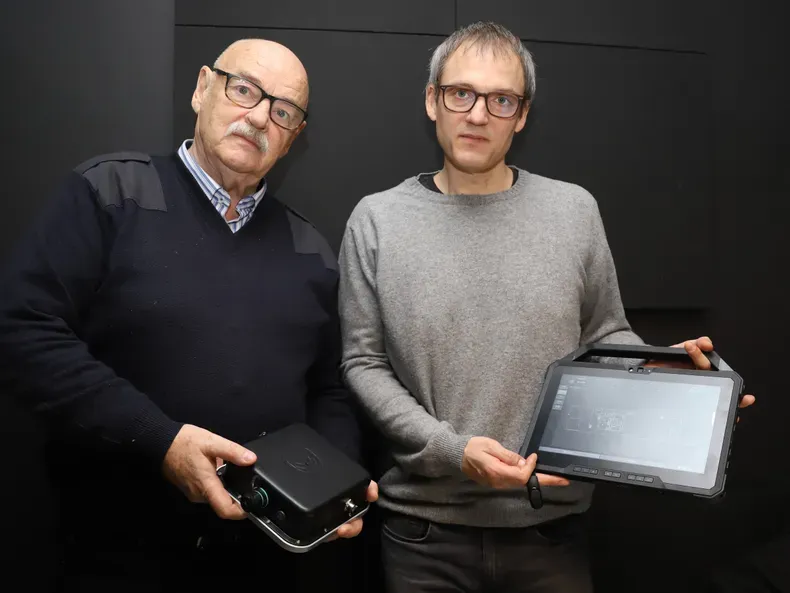
Father Audun and son Ronny Bakke with the safety equipment they believe can save many lives at sea.Photo : Tore Stensvold
Arm and frequency bands
For the users – whether crew or passengers – the visible part of the system is a wristband. It contains several chips, a data chip, which communicates wirelessly with reception boxes mounted around the ship.
We use a frequency band that was available for maritime use, says Bakke.
The number of nodes and their location depends on the customer’s needs and must therefore be adapted to each individual ship.
The system and software are based on open standards and almost plug-and-play.
Everything is built into a box that only requires assembly and installation of software, says Ronny Bakke.
Five shapes
The system combines several forms of communication, both Power Line Communication (PLC), Wi-Fi, Ethernet (ETH), fiber optic and Ultra Wide Band (UWB). According to Dimeq, this replaces a full network solution that can simultaneously perform hub functions for IoT devices (Internet of Things).
It provides redundancy. Anyone who has tried to communicate with wireless systems on board steel ships knows that it is not easy. The radio signals in a steel environment are difficult to control, says Bakke.
He believes that Dimeq has achieved a communication system with a capacity of 10-300 Mbps, which can help the entire maritime industry with the impending digitalisation.
The new low-orbit satellites, such as Starlink, are gradually arriving in the maritime industry and promise bandwidth of up to 250 Mbps. This combined with our solution opens up new frontiers for digitization at sea, says Bakke.
Two-way
Crew or passengers are not monitored in real time, but only when situations arise or when passing special nodes.
The system is also set up with two-way communication to allow “distress call” - that is, an emergency signal can be sent from the crew to the bridge, for example if one of the crew is in difficulty, or from the bridge to the crew when you need to get in touch with a specific person.
This also makes time in port more efficient. For cruise and passenger ships, everyone who disembarks is registered, and care is taken to ensure that everyone who is to continue is actually registered on board again.
Overboard
What the Bakke family is very happy with is an accelerometer/barometer that can detect people falling overboard. The position is registered, and the search can start immediately.
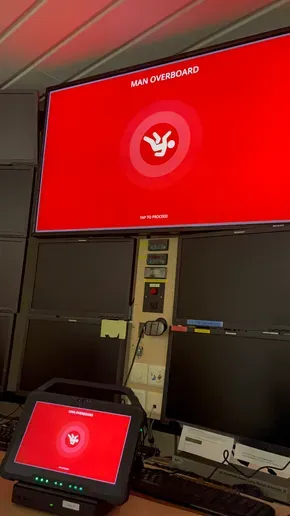
Alarm triggered: Man overboard (MOB). Photo: Dimeq
Father and son believe that their solution goes hand in hand with the authorities’ zero vision adopted by the Storting in April last year. The government has given the Norwegian Maritime Directorate the task of concretizing the work.
According to statistics from the Norwegian Maritime Directorate, 143 fishermen have fallen overboard in the last decade, 94 of whom died.
For the fishing fleet with small boats with only one or a few on board, we are also working on a solution that includes an emergency stop of the engine and notification via VHF radio (DSC channel 70) to Telenor Kystradio, says Bakke.
Fisheries
This project was started with support from the Norwegian Fisheries and Aquaculture Industry’s research funding (FHF). Sintef and the Rescue Society are partners in the project.
We are starting to get a foothold in the fishing fleet, says Bakke senior.
The system is being tested, among other things, on a 64-metre long ring-groove dredger, MS Vestfart. The shipping company Vestfart AS is based in Dimeq’s home municipality of Bremanger.
For us, it is important to be able to test the system in real situations and get useful feedback that can contribute to a better product. This is particularly important now that the government is looking at new regulations for safety on board fishing vessels, says Ronny Bakke.
Seismic
PGS, which has a large fleet of seismic vessels, has been a pilot customer for three or four years.
Ronny Bakke himself has experience from the seismic industry, but not at PGS.
I worked at CGG, but my father had acquaintances at PGS who put us in touch with the right people in the company, he says.
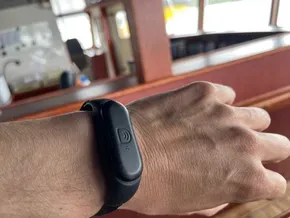
The electronic bracelet contains an accelerometer and a barometer. Photo: Dimeq
The father adds: - I made a phone call and was very well received. It was a door opener and an important contact for us so that we could also apply for support, including from Innovation Norway.
Maritime safety tools
Roger Honningdal, who is director of HSE (health, environment, safety) at PGS, thinks the Dimeq system looks very promising.
It will be very important for maritime safety when it is fully developed and functions as intended, says Honningdal to TU.
PGS has been involved and provided feedback along the way, from concept to testing of components and software.
We have not entered into a purchase agreement, but will test it out on one vessel first, says Honningdal.
He has been sailing for 25 years, including 13 years as captain. He immediately saw a potential for a system like the one Dimeq is developing.
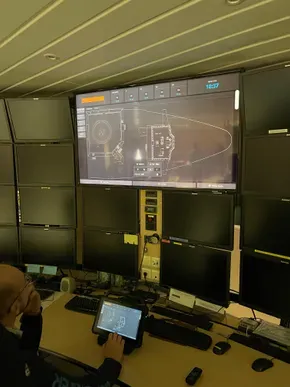
Large and small screen with an overview of crew with the Dimeq wristband on board a PGS seismic ship. PGS is involved as a pilot customer. Photo: Dimeq
Having control and an overview of the crew in an emergency is absolutely crucial. If you can avoid spending time looking for people and instead concentrate on solving the situation, a lot has been done, says Honningdal.
He says that the MOB function can also be good to have.
Although it is not that often that people fall overboard, it is crucial to find out as quickly as possible to have the opportunity to bring the person back alive, he says.
There is another Norwegian-developed system for the same type of crew and passenger control, Scan Reach, but it is based on different technology and does not have MOB functionality.
Support
The next milestone for Dimeq before commercial sales can really take off is product certification from NEMKO.
They have a long list of tests we must carry out in order to obtain certification. This applies to both vibrations, temperature ranges, water tightness and IP68. This will take three months, says Bakke.
Dimeq has received a lot of local backing and financial support from several bodies, but the biggest from Innovation Norway with seven to eight million kroner.
Among other important contributors, the Bakke family highlights Bremanger municipality, the Fisheries and Aquaculture Industry’s research funding, the accelerator program Aksello in Florø, Norges Sildesalgslag, Sparebank Vest, ÅKP Ålesund, Connect BAN in Bergen, Techstar Energy and Kongsberg Innovation.
Action plan
In line with the Storting’s decision, the government has launched a zero vision for those killed and seriously injured at sea. The Norwegian Maritime Directorate is tasked with drawing up an action plan. Then new tools can be an important piece.
Norway is a port nation, and many people have their jobs at sea. With a zero vision and a concrete action plan, we are taking a further step to ensure that everyone gets home safely from work at sea, says Fisheries and Oceans Minister Bjørnar Skjæran (Ap).
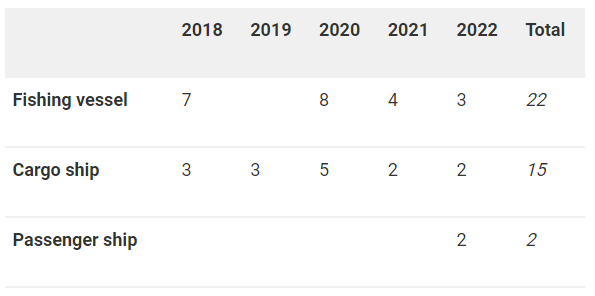
A total of 39 people have died from commercial vessels in the last five years. The death rate for seafaring in general, and fishing in particular, is significantly higher than for comparable occupations on land. Figures from the Norwegian Maritime Directorate show that 7 people died in connection with commercial vessels in 2022, and more than 450 were injured in accidents.
The Norwegian Maritime Directorate’s statistics on deaths at sea in the last five years:
Read in Norwegian at tu.no.
 ronny.bakke@dimeq.no
 +47 9740 1471