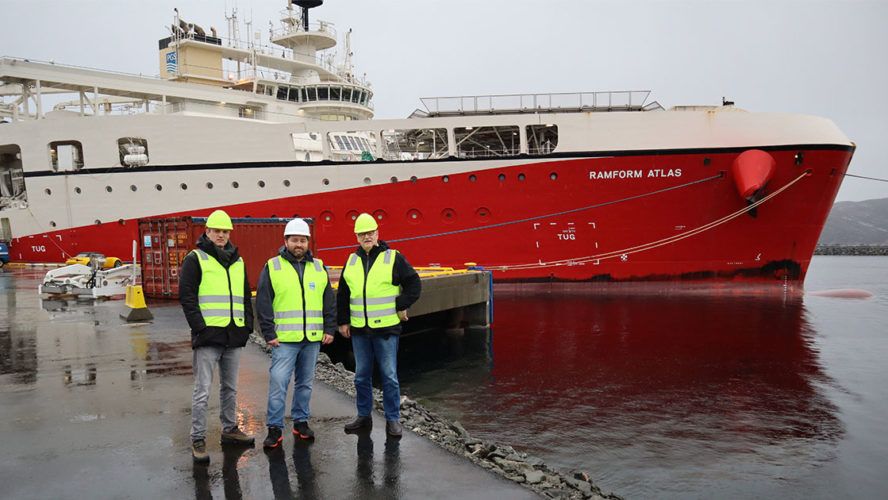
Dimeq has just signed the Acceptance Test with PGS which accepts the system and functionality.
A new Smart safety system will prevent drowning accidents
The new EyeD system, which has been developed by the Norwegian company Dimeq, can become an important tool in the fight against fatal accidents at sea.
Professional fishermen have Norway’s most dangerous profession. No other profession records more annual deaths. Dimeq wants to do something about this. With the newly developed EyeD system, they want to reduce the death statistics at sea.
In the years 2000-2019, 143 people who fell overboard were registered in the fishing fleet, and 94 of them have died. So the probability of surviving if you fall overboard is small. If it had happened in an industry on land, the company would have been shut down for the day, says Audun Bakke, co-owner, board member and HSE Manager at Dimeq.
A bracelet that saves lives
The Dimeq security system is based on a wristband with various sensors that locate the crew on board ships or oil platforms.
EyeD has real-time positioning, automated real-time detection of man overboard and automates all registration processes such as mustering crew on board, says Ronny Bakke, CEO of Dimeq.
If a person should fall overboard, it will trigger an alarm. This will enable rescue operations to be started immediately. This will increase the chance of saving lives.
It was not long ago that we had two cases of a man overboard in the Barents Sea, but where no one knew that someone had fallen overboard until several hours had passed. In such cases, they would have received an alarm as soon as someone fell overboard, if they had used the EyeD system, and the possibility of being rescued would have been considerably greater, says Audun Bakke.
Real-time positioning of personnel is linked to emergency situations such as fire or ground collision where the system is activated by an emergency alarm. During an evacuation, the captain must have a real-time overview of the crew and guests if this can be done, but apart from that the system is not a monitoring system.
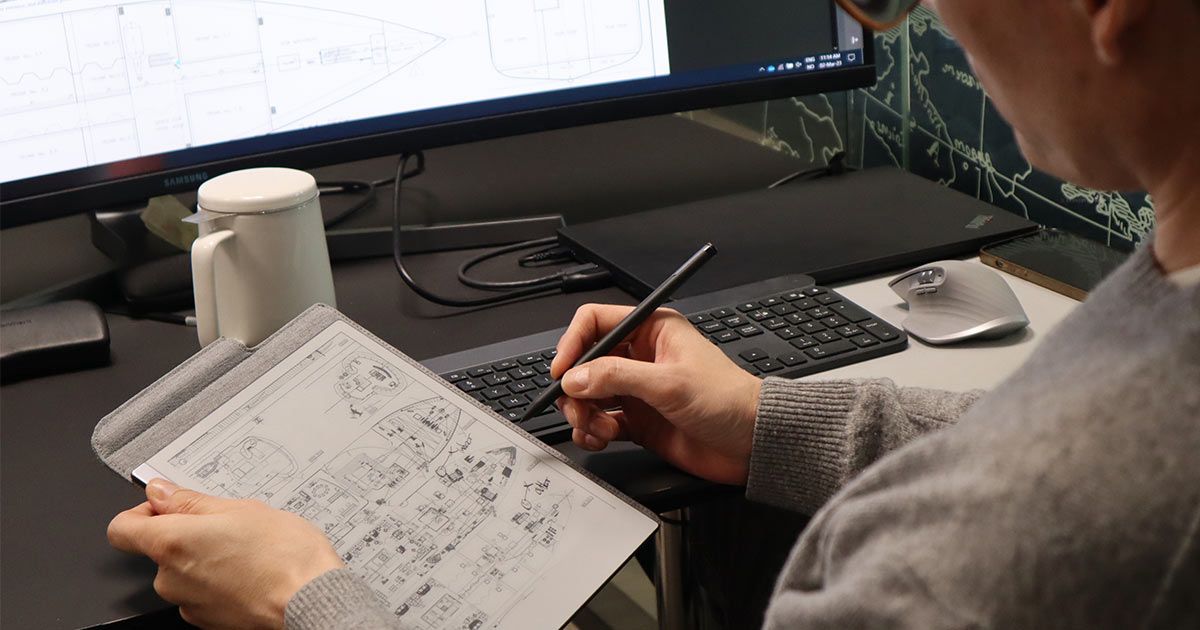 Ronny Bakke works with the hardware for the security system. Photo: Dimeq
Panic button
There is also a panic button on the bracelet. The button enables the crew themselves to trigger an emergency alarm should a dangerous situation arise and someone needs to be notified.
The bracelet has two-way communication, so it is also possible to send a vibration and light signal from the bridge out to the bracelet. When the crew receives the signal, they must contact the bridge immediately. This will make it easier and faster to contact the crew, especially on large vessels.
Zero vision at sea
The timing for this product could not be better.
A parliamentary decision has just been made on zero vision, and from what we understand, that ball has now been passed to the Norwegian Maritime Directorate. They must prepare measures to be introduced to achieve the zero vision, says Audun Bakke.
He believes that the bracelet based on the EyeD system has several functions that can be good measures to accommodate this zero vision.
Unique communication platform
When Dimeq first started working with safety at sea, they quickly realized why similar systems had not been developed before. The problem was the internal communication on board in a steel environment which makes wireless communication difficult.
Then we started researching how to do this, and found a completely unique way of doing it. We use the electrical network on board the ship to send data, and then we avoid installing extra cabling, says Ronny Bakke.
They combine this with a Wi-Fi-Mesh radio technology, and thus it is possible to have communication throughout the boat, without large installations.
We have developed a unique communication platform almost without cabling and at high speed, says Ronny Bakke.
Digitization opens up new possibilities
As far as we know, we are the first to use the electrical network on board a vessel to send data in this way, says Ronny Bakke.
The new technology will make it possible to develop smart vessels and smart security. This will make it possible to analyze and use artificial intelligence to design better boats in the future and understand how the crew moves.
Digitization of smart boats opens up enormous possibilities: remotely controlled medical operations on board, keeping track of the cargo, preventing fires and keeping control of dangerous goods. This can make it less risky and more effective. You save money by having full control over things, says Lars Johan Frigstad, working chairman of Dimeq.
The company is now experiencing increased attention from the media and from various customers and partners. In particular, we see interest from fishing vessels, the farming industry, wind turbines and offshore.
PGS has been a very good partner in the development of our system, and the first installation on a large seismic ship is expected during the year. Kongsberg Innovation is one of our owners and has been useful during conversations with possible partners.
Bringing in six million kroner
Right now they are going to start an issue that will help finance the certification of the product so that the first commercial contracts can begin.
We now want to go out and collect NOK six million, and that is to take us to the commercialization stage with the first contracts. Our product has been installed, it has been fully developed on the first ship, and since December 1st we have been operational. But the product is not product approved, so that the money we are now going to raise will go towards getting a final product that is certified and in commercial operation, concludes Frigstad.
Translated from Norwegian version of this article published in www.altomsamfunnssikkerhet.no.
 ronny.bakke@dimeq.no
 +47 9740 1471